Posted on November 27, 2026
Immaterial And An Elephant
The GOP means almost nothing now
by
Daniel Clark
Contrary to
many of the electoral postmortems, the downfall of the Republican Party has
been neither sudden nor mysterious, nor is it attributable to a single issue
like tariffs or the Iran War.
Ultimately, it's a matter of common sense. Or at least, it's a matter of the polical use
of the phrase "common sense" as shorthand for unprincipled populism. This semantic tactic was brought to us by
Matt Schlapp, chairman of the Conservative Political Action Conference, an
annual gathering whose title sounds almost sarcastic these days.
 In acknowledgment of the wayward
drift of his organization, Schlapp declared in 2022 that "we are no longer
conservatives," and began promoting the phrase "common sense" to describe his
beliefs, or lack thereof. Donald Trump,
whose personality had long since supplanted any ideology as the focus of CPAC,
took his rhetorical cue from Schlapp, and began saturating his speeches and
social media posts, not to mention the Republican Party Platform, with the
phrase "common sense." But what is that,
exactly?
Every
person thinks his own judgment is sensible, which makes the term almost entirely
subjective. As long as the Republican
Party remains completely invested in Donald Trump, then any decision he makes,
no matter how impetuous or silly, automatically becomes "common sense." One of his policies doesn't even have to be
consistent with another. He can
flip-flop on the same question multiple times within a week. It doesn't matter. In a way, it's even preferable, because in
Schlappian terms, "common sense" is defined as being unmoored from conservative
principles.
As if to
emphasize this point, the Trump Justice Department announced during the midterm
campaign that it is working to clear the name of Richard Nixon, not exactly a
winning issue or a wise use of taxpayer-funded resources. This is only the latest example of an ongoing attempt to
rehabilitate the reputation of the Trixter.
Nixon fetishism has become a common theme among Trump-friendly
influencers, who refer to their obsession as "Nixonmaxxing." Failed Ohio gubernatorial candidate Vivek
Ramaswamy calls him "the most underappreciated president of our modern history." In a speech at the Nixon Library, Vice
President J.D. Vance praised the ex-prez, and not coincidentally likened him to
himself.
One could
hardly select a more fitting Republican icon for adherents to ideological
nothingness. Like Trump, Nixon sometimes
promoted himself as a conservative culture warrior, the self-appointed leader
of the "silent majority." As president, however,
he seemed to determine his policy positions by throwing darts. Some of them were not only left-wing, but
extremely so.
Nixon
pioneered the practice of "ending" a war instead of finishing it, by
negotiating a duplicitous deal that gave him an out, even though he knew the
enemy would disregard it once he withdrew.
He implemented price controls and affirmative action, and created the
EPA, not in compromises with the Democrats, but as his own initiatives. He pursued detente with the Soviet Union, and
hamstrung American missile defenses by signing the ABM Treaty. In his post-presidency, he repeatedly prodded
the GOP to drop its defense of innocent, unborn human life.
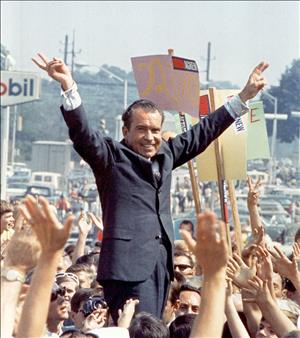 The Trumpies are not so kind to
Ronald Reagan. They routinely deride
conservatives as "zombie Reaganites," the point being that our beliefs are
relics of a bygone era, even as they reach a decade farther into the past. They're careful not to directly criticize the
popular former president, but they denounce his policies with such epithets as
"free market fundamentalism" and "foreign policy idealism," and why wouldn't
they? He was the personification of the
very sort of conservative ideological consistency they loathe.
The Reagan
agenda has often been described as a three-legged stool, the legs representing fiscal,
social and foreign policy conservatism.
The implication is that it cannot stand in the absence of any one of
them. By now, all three have been sawed
off, leaving the Republican elephant nowhere to go but flat on its butt.
Trump's
defining fiscal policy has been unprecedentedly high, weakly justified and
economically chaotic taxes on the importation of goods. He has repeatedly said "tariff" is "the most
beautiful word in the English language," and bragged about how much money he
has siphoned out of the economy by imposing them. Although he often claims tariffs are paid by
foreign governments, he admits the truth of the matter whenever he scales them
back on certain items in order to lower prices.
All this in spite of the fact that the power to levy tariffs rightly
belongs to Congress, both houses of which have been under Republican control until
now. Not only have they done nothing to restrain
him, but few have even expressed disapproval.
Harmful as
the tariffs have been, far greater long-term damage is bound to be done by the
melding of the federal government with the business sector, which self-described
"anti-fascists" would call fascism, had they ever bothered to look up the word. The fact that the President of the United
States has just chosen the CEO of a corporation has been met by his fellow
Republicans with more bewilderment than outrage. Before long, it will be accepted as the new normal,
just as the acquisition of shares of corporations on behalf of the government
has been. During Trump's second term,
Uncle Sam has become part-owner of 41 private companies, according to a running
tally kept by the libertarian Cato Institute.
Whenever a new one is added to the list, it isn't even treated as
newsworthy anymore.
 One policy in which congressional
Republicans have been actively complicit is the creation of Trump Accounts,
federally administered saving accounts for children, each of which receives a
thousand dollars in seed money provided by the taxpayers, and which will be
partially funded by philanthropic contributions. No sooner were they created than President
Trump and Republican Sen. Bernie Moreno of Ohio proposed expanding the program
to include adults up to the age of forty.
If this idea ever comes to fruition, it could render the American people
dependent on the largesse of corporate benefactors, who will have entered into
a mutually corruptive arrangement with Washington.
Trump has
been willing to take on social issues like transgenderism, on which he enjoys massive
public support, but what about when public opinion is split? Whether he likes it or not (and he doesn't),
abortion remains the dominant social issue, as the legality of killing innocent
human beings inevitably must be.
During his
first presidential campaign, Trump promised to overturn Roe v. Wade, a
pledge that reveals a Trumpian understanding of American civics (and that's not
a compliment). The truth be known, he
was never any more serious about that than he was about making Mexico pay for a
border wall. It's true that in his first
term he agreed to pick his Supreme Court nominees from a list provided by
conservative think tanks, and that he was faithful to this agreement, but he
had no reason to expect that he'd be making three appointments. When the Court really did overturn Roe
he was uncharacteristically reticent to comment on social media, and once he
saw how the ruling energized the opposition, he couldn't run away from the
issue fast enough.
In 2024,
Trump removed the pro-life plank from the party platform, which he required the
convention platform committee to vote on without any opportunity for debate or
amendment. His betrayal ran a lot deeper
than that, though. He spoke openly about
taking the issue "off the table" by leaving it to be decided at the state
level, but undermined the enforcement of state pro-life laws by allowing the
illegal interstate distribution of abortion pills by mail to continue unabated. When he promised not to enforce the relevant
provisions of the Comstock Act, vice presidential candidate J.D. Vance agreed
with this decision, and most other Republicans shrugged.
 The Trumpified Republicans have not
confined their departures from social conservatism to policy, however. They've also accelerated the coarsening of
our culture by the actions and words of Trump and those who mimic him. It has gotten to the point where people shouldn't
want their children to watch or listen to the president anymore. For more than ten years now, he has regularly
used foul language in TV and radio interviews, indulged in constant self-flattery
while pelting others with childish insults, posted vulgar memes, including one
of himself dropping a planeload of excrement on protestors, personally attacked
reporters who ask him undesirable questions and encouraged his press secretary
to do the same, frequently doubled down on claims that he surely knows to be
false and corrupted others into backing him up, subjected subordinates to
demeaning loyalty tests, required cabinet secretaries to grovel before him in
televised meetings, and generally behaved as if he were the incarnation of at
least three of the seven deadly sins.
The responses
of his fellow Republicans have usually been to rationalize these behaviors as
the price to be paid in exchange for Trump's overall wonderfulness, or to
encourage them by tee-heeing over his loveable naughtiness. The only instances in which they've been
willing to condemn his social media posts have been when he portrayed himself
as Jesus Christ, and when he reveled in the deaths of people he didn't like. Is that where the bar has been set now?
The GOP has
followed Trump down the path of "foreign policy realism," which is one of the most
appalling euphemisms in politics. That
term refers to a worldview that dictates foreign policy by self-interest, untempered
by moral considerations. As long as the "realists"
rule, the United States is not to be a bulwark of freedom, but only another
animal in the wilderness. In short, it's
a belief that the character of a nation doesn't matter.
If it
behooves us to minimize conflict with Russia, then "realistically," we should
side with Russia over Ukraine because the Ukrainians cannot threaten us. The fact that Ukraine long ago upheld its end
of the Budapest Memorandum by giving up its nukes means we've already got what
we wanted, so we're free to welch on our part of the agreement. If our longtime ally Denmark has a possession
we would rather have for ourselves, there's nothing wrong with threatening the
Danes, and causing a peaceful people to live in fear of Americans. If we can coerce a favorable oil agreement
from the sitting government of Venezuela, then we must forsake the victims of
its oppression and prop up the Communists instead. Once, Trump even suggested that he would call
off the war in Iran in exchange for a partnership with the Mullahs to divide the
revenue from illegal tolls in the Strait of Hormuz. Is that realism? Is that common sense?
 A central theme of the Trump 2016
primary campaign was that the party was dominated by entrenched establishment
Republicans who were quick to sell out our principles, which was often
true. Since he was first elected president,
that gradually morphed into the message that it was our principles that were
the problem. By the 2024 Republican National
Convention, conservatives were not even welcome.
And why
was this transformation necessary?
Because Trump was a winner, and he was showing Republican losers how to
win, that's why. Until his arrival, the
Republicans had never, ever won anything, the elections of 1994, 2000, 2002,
2004 and 2010 notwithstanding. So how
does the Trump record compare to that?
* 2016 --
Donald Trump wins the presidency in a very close race, against one of the worst
major party nominees of all time.
* 2018 --
The Republicans gain two seats in the Senate, but lose the majority in the
House, where the Democrats pick up 41 seats.
* 2020 --
Trump loses the presidency in a close election against one of the worst major
party nominees of all time. The
Republicans gain 13 seats in the House, but lose three Senate seats, giving the
Democrats control of both houses of Congress.
* 2022 --
In what was expected to be a massive midterm victory for the GOP during an unpopular
Democrat presidency, Republicans only pick up nine seats in the House, while
the Democrats increase their Senate majority by one. The failure of the Republican Party to
recapture the Senate is a direct result of the quality of Trump's hand-picked
nominees.
* 2024 --
Trump wins back the presidency in a close race against one of the worst major
party nominees of all time. The
Republicans take back control of the Senate by gaining four seats, while their
slender majority in the House dwindles by two.
* 2026 -- In
an election that both parties agreed to turn into a referendum on President Trump,
his party suffers a massive defeat in both houses of Congress. With a handful of House races yet to be
decided, the Republicans are down by 44 seats and counting. The Democrats regain control of the Senate by
a wide margin, adding a total of nine seats, including shocking results in GOP
strongholds of Texas, Kansas, South Carolina and Mississippi, for a lopsided
56-44 majority.
With the
Trump era ending in two years, the increasingly irrelevant Republicans need to
come up with a plan for pulling themselves out of this fiery debris, but which
way can they go? As much as pundits like
to refer to something called "Trumpism," the president does not leave behind any
coherent philosophy for his party to follow.
Do Republicans simply try to find a new charismatic leader, follow that
person's whims wherever they may lead, and call it common sense?
Those Republicans
who cast aside their professed beliefs in order to follow Trump cannot credibly
go back and reclaim them now, but neither can the party afford to wait for a whole
new generation to come along and replace them.
That would seem to leave the GOP right where it is for the immediate
future, which is lost. The party of
common sense should have thought of that, before spending the past decade
following a man without a compass.
The Shinbone: The
Frontier of the Free Press